Social science research is a systematic and methodical exploration of human behaviour, societal structures, and the intricate interactions that shape our world. Spanning disciplines such as sociology, psychology, anthropology, economics, and political science, it offers diverse perspectives on how individuals and groups function within their environments. At its core, social science research seeks to identify patterns, understand causal relationships, and generate insights that inform policies, practices, and theories. By employing both qualitative and quantitative methods, researchers aim to answer pressing questions about social phenomena—from interpersonal relationships to the broader forces driving economic and political change.
A strong understanding of social science research is essential for critically engaging with the world. It equips individuals with the tools to evaluate evidence, challenge assumptions, and make informed decisions in personal, professional, and policy contexts. Whether analyzing social policies, cultural norms, or economic trends, social science research provides a structured framework for interpreting the complexities of human society.
Within the broader realm of social science, political science research focuses specifically on the study of political phenomena, examining governance structures, power dynamics, and public policy processes. Using diverse methodologies—including quantitative analysis, qualitative case studies, and theoretical modelling—political science research investigates key issues such as political institutions, electoral systems, international relations, and public opinion. By identifying patterns, testing hypotheses, and generating evidence-based insights, this field seeks to explain how political systems function, predict outcomes and guide decision-making. Political science research plays a crucial role in fostering informed citizenship, shaping effective policies, and addressing complex global challenges, making it a cornerstone of both academic inquiry and practical governance.
Table of Contents
Meaning of Research
Research, in simple terms, refers to the pursuit of knowledge. It can be defined as a scientific and systematic search for relevant information on a specific topic, making it an art of scientific investigation. According to The Advanced Learner’s Dictionary of Current English, research is “a careful investigation or inquiry, especially through the search for new facts in any branch of knowledge.” Redman and Mory describe it as a “systematized effort to gain new knowledge.” For many, research represents a journey from the known to the unknown—a voyage of discovery. Humans are naturally inquisitive, and when faced with the unknown, this curiosity drives us to explore and seek a deeper understanding. This innate desire to question and learn is the foundation of all knowledge, and the method we use to uncover the unknown is what we call research.
As an academic activity, research has a technical meaning. Clifford Woody explains that research involves defining and redefining problems, formulating hypotheses, collecting and evaluating data, drawing conclusions, and rigorously testing these conclusions to see if they align with the initial hypotheses. Similarly, D. Slesinger and M. Stephenson, in the Encyclopaedia of Social Sciences, define research as “the manipulation of things, concepts, or symbols to extend, correct, or verify knowledge, whether for constructing theory or practicing an art.” Research is, therefore, an original contribution to the existing body of knowledge, driving its advancement. It is the pursuit of truth through study, observation, comparison, and experimentation. In essence, research is the systematic and objective search for knowledge to solve problems, formulate theories, and establish generalizations. It involves a structured process of identifying a problem, proposing a hypothesis, gathering and analyzing data, and arriving at conclusions that either address the problem or contribute to theoretical understanding.
Objectives of Research
The primary goal of research is to uncover answers to questions through the application of scientific methods. Its fundamental aim is to reveal hidden truths that have yet to be discovered. While each research study has its own specific purpose, the objectives of research can generally be categorized into the following broad groups:
- To gain familiarity with a phenomenon or to achieve new insights into it (such studies are referred to as exploratory or formulative research);
- To accurately describe the characteristics of a particular individual, situation, or group (these are known as descriptive research studies);
- To determine the frequency of an occurrence or its association with other factors (studies with this focus are called diagnostic research studies);
- To test hypotheses about causal relationships between variables (such studies are termed hypothesis-testing research).
Motivation in Research
What drives individuals to undertake research? This is a question of great significance. The motivations for engaging in research can include one or more of the following:
- The desire to earn a research degree and the benefits that come with it;
- The urge to tackle unsolved problems and address practical challenges;
- The intellectual satisfaction derived from engaging in creative work;
- The aspiration to contribute to society and make a meaningful impact;
- The wish to gain respect and recognition.
However, these are not the only factors that motivate people to pursue research. Other influences, such as government directives, employment requirements, curiosity about new phenomena, the desire to understand cause-and-effect relationships, and broader social awareness, can also inspire or even compel individuals to engage in research activities.
Types of Research
Research can be categorized into several basic types based on its nature, purpose, and methodology:
Descriptive vs. Analytical Research: Descriptive research focuses on describing the state of affairs as they exist. It includes surveys and fact-finding inquiries, often used in social science and business research. A common form is ex post facto research, where the researcher has no control over variables and can only report what has happened or is happening. This type of research is used to measure phenomena like shopping frequency, consumer preferences, or other similar data. Analytical research, on the other hand, involves the critical evaluation of existing facts or information to draw conclusions or make assessments.
| Aspect | Descriptive Research | Analytical Research |
|---|---|---|
| Definition | Research that describes characteristics, behaviours, or phenomena as they exist. | Research that examines data, evaluates evidence and interprets findings to establish relationships or causes. |
| Purpose | To provide a detailed account of a subject without explaining “why” it happens. | To analyze “why” and “how” something occurs by evaluating information. |
| Approach | Observational, fact-finding, and qualitative or quantitative. | Critical analysis, interpretation, and evaluation of existing information. |
| Data Collection | Surveys, case studies, observational studies, and historical reviews. | Experiments, statistical analysis, comparative studies, and logical reasoning. |
| Nature of Study | Descriptive and non-explanatory. | Explanatory and interpretative. |
| Examples | Market research surveys, population studies, and social trend analysis. | Cause-and-effect studies, legal analysis, and economic impact studies. |
| Outcome | Provides a snapshot or detailed picture of a subject. | Provides insights, explanations, or conclusions based on analysis. |
Applied vs. Fundamental Research: Applied research aims to solve immediate, practical problems faced by society, businesses, or organizations. For example, marketing research or policy evaluation falls under this category. In contrast, fundamental (or basic) research seeks to expand theoretical knowledge and formulate generalizations. Examples include studies on natural phenomena or human behaviour aimed at developing broader theories. While applied research is solution-driven, fundamental research focuses on advancing scientific knowledge for its own sake.
| Feature | Applied Research | Fundamental Research |
|---|---|---|
| Definition | Research aimed at solving specific, practical problems. | Research conducted to enhance theoretical understanding without immediate application. |
| Purpose | To develop new technologies, products, or processes. | To expand knowledge and discover new theories or principles. |
| Focus | Real-world applications and problem-solving. | Understanding fundamental concepts and principles. |
| Outcome | Practical solutions, innovations, and improvements. | Theories, models, and principles that explain phenomena. |
| Example Fields | Engineering, medicine, business, environmental science. | Physics, chemistry, biology, mathematics, social sciences. |
| Timeframe for Results | Short-term to medium-term; results are often implemented quickly. | Long-term; results may not have immediate practical use. |
| Funding Sources | Industry, government agencies, private companies. | Universities, government grants, and research institutions. |
| Methodology | Uses existing theories and principles to solve specific problems. | Explores new concepts, hypotheses, and fundamental laws. |
| Innovation Type | Incremental improvements and innovations. | Groundbreaking discoveries and paradigm shifts. |
| Example | Developing a new vaccine for a disease. | Studying the genetic basis of immunity. |
Quantitative vs. Qualitative Research: Quantitative research deals with measurable quantities and is used to study phenomena that can be expressed numerically. Qualitative research, however, focuses on understanding qualitative phenomena, such as human behaviour, motivations, and attitudes. Techniques like in-depth interviews, word association tests, and projective methods are commonly used in qualitative research. This type of research is particularly important in behavioural sciences, where the goal is to uncover underlying motives and desires.
| Feature | Quantitative Research | Qualitative Research |
|---|---|---|
| Definition | Research that focuses on numerical data, statistics, and measurable outcomes. | Research that explores subjective experiences, meanings, and non-numerical data. |
| Objective | To quantify variables and establish patterns, relationships, or trends. | To understand deeper meanings, behaviours, and motivations. |
| Data Type | Numerical, structured data. | Non-numerical, descriptive, and unstructured data. |
| Methods | Surveys, experiments, structured observations, statistical analysis. | Interviews, focus groups, case studies, ethnography. |
| Analysis | Statistical and mathematical analysis (e.g., mean, correlation, regression). | Thematic analysis, content analysis, and narrative interpretation. |
| Data Collection | Standardized instruments like questionnaires, tests, and databases. | Open-ended questions, direct observations, personal interactions. |
| Sample Size | Large, representative samples for generalizability. | Small, focused samples for in-depth understanding. |
| Nature of Results | Objective, measurable, and replicable findings. | Subjective, exploratory, and context-dependent insights. |
| Research Design | Structured, follows a predetermined hypothesis and methodology. | Flexible, and evolves based on data collection and researcher insights. |
| Application | Used in sciences, business, medicine, and economics. | Used in psychology, sociology, anthropology, and humanities. |
| Limitations | May not capture deeper insights or emotions. | Results may be harder to generalize and subject to researcher bias. |
Conceptual vs. Empirical Research: Conceptual research involves abstract ideas or theories and is often used by philosophers to develop or reinterpret concepts. Empirical research, on the other hand, is based on observation and experimentation. It relies on firsthand data collection and aims to verify hypotheses through systematic investigation. Empirical research is characterized by the researcher’s control over variables and deliberate manipulation of conditions to study their effects.
| Feature | Conceptual Research | Empirical Research |
|---|---|---|
| Definition | Research-based on abstract ideas, theories, and concepts. | Research is based on observation, experiments, or real-world data. |
| Nature | Theoretical and analytical. | Practical and data-driven. |
| Purpose | Develop new theories, models, or frameworks. | Test hypotheses, validate theories, or find empirical evidence. |
| Approach | Deductive (reasoning from general to specific). | Inductive (reasoning from specific to general). |
| Methodology | Literature review, logical reasoning, and theoretical analysis. | Experiments, surveys, case studies, observations. |
| Data Type | Secondary data from existing sources, theories, or expert opinions. | Primary data is collected through experiments, surveys, or field studies. |
| Examples | Philosophy, ethics, mathematics, and theoretical physics. | Psychology, medicine, social sciences, natural sciences. |
| Outcome | New theories, models, or frameworks. | Measurable results, conclusions, and practical applications. |
| Reliability | Based on logical consistency and coherence. | Verified through experimentation and statistical analysis. |
| Limitations | May lack real-world validation or practical application. | Can be limited by sample size, bias, or measurement errors. |
Other Types of Research: Research can also be classified based on time, environment, or purpose. For instance, one-time research is conducted within a single time period, while longitudinal research spans multiple periods. Research can be conducted in field settings, laboratories, or through simulations. Clinical or diagnostic research delves deeply into causal relationships using case studies or in-depth approaches. Exploratory research aims to develop hypotheses, whereas formalized research tests specific hypotheses. Historical research uses documents and remains to study past events or ideas. Additionally, research can be conclusion-oriented, where the researcher has the freedom to explore and conceptualize, or decision-oriented, which is driven by the needs of decision-makers, such as in operations research.
One-time (Cross-sectional) vs. Longitudinal Research:
| Feature | One-time (Cross-sectional) Research | Longitudinal Research |
|---|---|---|
| Definition | A study conducted at a single point in time. | A study conducted over a period of time with repeated observations. |
| Objective | Provides a snapshot of a population or phenomenon. | Tracks change and trends over time. |
| Data Collection | Data is collected once. | Data is collected multiple times at different intervals. |
| Time Frame | Short-term study. | Long-term study. |
| Cost | Generally lower cost. | More expensive due to repeated data collection. |
| Effort | Less complex, and requires fewer resources. | More complex, and requires continuous tracking of participants. |
| Suitability | Best for descriptive and comparative studies. | Best for understanding changes, causality, and development over time. |
| Example Studies | A survey on consumer preferences at one point in time. | A study tracking the same individuals’ health behaviours for 10 years. |
| Limitations | Cannot analyze changes over time; risk of cohort effects. | Risk of participant dropout (attrition), higher resource demands. |
Conclusion-Oriented and Decision-Oriented Research:
| Feature | Conclusion-Oriented Research | Decision-Oriented Research |
|---|---|---|
| Objective | To develop theories, principles, or general conclusions. | To provide specific information for decision-making. |
| Focus | Knowledge generation and understanding. | Problem-solving and practical applications. |
| Scope | Broad and exploratory. | Narrow and specific to a particular decision. |
| Timeframe | Long-term perspective. | Short-term, immediate decision-making needs. |
| Methodology | Uses qualitative and quantitative methods to explore theories. | Uses data analysis and modelling to support decision-making. |
| Examples | Academic research, scientific studies. | Business research, market analysis, and policy evaluation. |
| End-User | Scholars, researchers, and academicians. | Managers, policymakers, and business executives. |
| Flexibility | More flexible, allowing exploration. | More structured, aiming at specific solutions. |
Each type of research serves distinct purposes and employs unique methodologies, making it essential to choose the appropriate approach based on the research objectives and context.
Research Approaches
The discussion of research types highlights two fundamental approaches to research: the quantitative approach and the qualitative approach.
The quantitative approach involves generating data in numerical form, which can be rigorously analyzed using formal and structured methods. This approach can be further divided into three subcategories:
- Inferential Approach: This method aims to create a data base from which characteristics or relationships of a population can be inferred. It typically involves survey research, where a sample of the population is studied (through questioning or observation) to determine its characteristics. These findings are then generalized to the entire population.
- Experimental Approach: This approach is characterized by greater control over the research environment. Researchers manipulate certain variables to observe their effects on other variables, allowing for the establishment of cause-and-effect relationships.
- Simulation Approach: This involves creating an artificial environment to generate relevant data and observe the dynamic behaviour of a system (or its subsystems) under controlled conditions. In business and social sciences, simulation refers to the operation of a numerical model that represents the structure of a dynamic process. By setting initial conditions, parameters, and variables, researchers can simulate the behaviour of a process over time. This approach is particularly useful for modelling and understanding future scenarios.
On the other hand, the qualitative approach focuses on the subjective assessment of attitudes, opinions, and behaviours. It relies heavily on the researcher’s insights and impressions, often producing results that are non-quantitative or not suited for rigorous quantitative analysis. Common techniques used in qualitative research include focus group interviews, projective techniques, and depth interviews. These methods are designed to explore underlying motivations, perceptions, and experiences in a nuanced and detailed manner.
| Aspect | Quantitative Approach | Qualitative Approach |
|---|---|---|
| Definition | Uses numerical data and statistical methods to analyze patterns and relationships. | Uses non-numerical data such as words, images, or observations to explore meanings and experiences. |
| Purpose | To measure, test hypotheses, and generalize findings. | To explore, understand, and interpret phenomena in depth. |
| Nature of Data | Numerical data (e.g., surveys, experiments). | Descriptive data (e.g., interviews, observations, case studies). |
| Data Collection Methods | Surveys, experiments, structured observations, and statistical reports. | Interviews, focus groups, participant observations, and open-ended surveys. |
| Analysis Method | Statistical analysis (e.g., regression, correlation, mean, standard deviation). | Thematic analysis, coding, narrative analysis, and content analysis. |
| Sample Size | Large, representative samples. | Small, purposive samples. |
| Research Design | Structured, fixed, objective. | Flexible, evolving, subjective. |
| Generalizability | High (findings can be applied to larger populations). | Low (findings are specific to the studied context). |
| Researcher’s Role | Objective, detached from participants. | Subjective, interacts with participants. |
| Examples | Market research surveys, clinical trials, and census data analysis. | Ethnographic studies, interviews about personal experiences, and case studies. |
| Strengths | Provides precise, reliable, and generalizable results. | Offers rich, in-depth insights into complex issues. |
| Limitations | Lacks depth and context; may ignore underlying meanings. | Time-consuming, difficult to generalize, and potential researcher bias. |
Both approaches serve distinct purposes and are chosen based on the nature of the research problem and the type of data required. While the quantitative approach emphasizes measurement and statistical analysis, the qualitative approach prioritizes understanding and interpreting complex human behaviours and social phenomena.
Significance of Research
The famous Hudson Maxim, “All progress is born of inquiry. Doubt is often better than overconfidence, for it leads to inquiry, and inquiry leads to invention,” aptly captures the essence of research. Research drives progress by fostering scientific and inductive thinking, promoting logical habits of thought, and encouraging systematic organization. Its significance spans various domains, including economics, business, government, and social sciences, making it an indispensable tool for decision-making and problem-solving.
In the realm of applied economics, research plays a pivotal role in addressing both business and broader economic challenges. The growing complexity of business operations and government functions has heightened the reliance on research to tackle operational issues. As a tool for shaping economic policy, research has become increasingly vital for both governments and businesses. For instance, government budgets are informed by research that analyzes public needs, desires, and revenue availability. Research helps devise and evaluate alternative policies, enabling policymakers to make informed decisions. Governments also rely on research to design programs addressing economic and social conditions, such as agricultural challenges, industrial issues, labour conditions, and defence strategies. Furthermore, research is essential for collecting and interpreting data on the nation’s economic and social structure, providing insights into ongoing changes and future trends.
This process involves three key phases:
- investigating the economic structure through continuous data compilation,
- diagnosing current events and analyzing underlying forces, and
- predicting future developments.
In business and industry, research is critical for solving operational and planning problems. Market research, operations research, and motivational research are particularly significant. Market research examines market structures and trends to inform purchasing, production, and sales strategies. Operations research applies mathematical and analytical techniques to optimize business outcomes, such as minimizing costs or maximizing profits. Motivational research delves into consumer behaviour, uncovering the reasons behind market preferences and actions. These research forms enable businesses to make logical, data-driven decisions, replacing intuition with scientific precision. For example, demand forecasting allows firms to adjust supply schedules efficiently, while sales estimates form the basis for budgeting, production planning, and investment strategies.
Research is equally vital for social scientists, who use it to study social relationships and address societal issues. It offers intellectual satisfaction by expanding knowledge for its own sake while also providing practical solutions to real-world problems. Social science research balances the pursuit of theoretical principles with the application of findings to improve human interactions and solve immediate social challenges.
Beyond its practical applications, research holds personal significance for various individuals:
- For students pursuing master’s or doctoral degrees, research represents a pathway to career advancement and social recognition.
- For research professionals, it is a source of livelihood and professional fulfilment.
- For philosophers and thinkers, research serves as an outlet for new ideas and insights.
- For writers and artists, it fuels creativity and the development of new styles.
- For analysts and intellectuals, it enables the formulation of new theories and generalizations.
In essence, research is the foundation of knowledge and a guiding force for addressing business, governmental, and social challenges. It serves as a formal training mechanism, equipping individuals with the skills to comprehend and adapt to new developments in their respective fields. By bridging the gap between theory and practice, research empowers societies to progress and thrive.
Research Methods versus Methodology
At this point, it is important to clarify the distinction between research methods and research methodology. Research methods refer to the specific techniques and procedures used to conduct research. These are the tools and approaches researchers employ to carry out their investigations. In other words, research methods encompass all the techniques used by researchers to study and address their research problems.
Given that the goal of research, particularly applied research, is to find solutions to specific problems, it is essential to establish a connection between available data and the unknown aspects of the problem. With this in mind, research methods can be categorized into three groups:
- Data Collection Methods: These include techniques used to gather data when existing information is insufficient to solve the research problem.
- Statistical Techniques: These methods are used to analyze relationships between data and the unknowns, helping to establish connections and patterns.
- Evaluation Methods: These techniques are employed to assess the accuracy and reliability of the results obtained.
The methods in the latter two groups are often regarded as analytical tools in research.
On the other hand, research methodology is the systematic framework used to solve a research problem. It is the science of understanding how research is conducted scientifically. The methodology involves studying the steps and logic behind the approaches researchers take to investigate their problems. It goes beyond merely knowing how to apply specific techniques; it requires an understanding of why certain methods are chosen, their underlying assumptions, and their relevance to the research problem.
For instance, researchers must not only know how to calculate statistical measures like mean, median, mode, standard deviation, or chi-square but also understand when and why these techniques are appropriate. They need to evaluate the assumptions behind each method and determine which techniques are suitable for specific problems. This means that researchers must design a methodology tailored to their unique research problem, as the approach may vary depending on the context.
To illustrate, consider an architect designing a building. The architect must consciously evaluate the rationale behind each decision, such as the size, number, and placement of doors, windows, and materials. Similarly, in research, scientists must justify their methodological choices, explaining why they selected particular methods and how these decisions contribute to the study’s validity. This transparency allows others to evaluate the research process and outcomes.
In summary, research methodology encompasses a broader scope than research methods. While research methods are the specific tools used in research, the methodology involves the rationale, logic, and systematic planning behind those methods. When discussing research methodology, we address questions such as why the study was undertaken, how the problem was defined, why specific hypotheses were formulated, what data were collected, and why particular analytical techniques were chosen. By addressing these questions, researchers ensure that their work is rigorous, transparent, and open to evaluation by both themselves and others.
Here’s a clear comparison between Research Methods and Research Methodology:
| Aspect | Research Methods | Research Methodology |
|---|---|---|
| Definition | Specific tools, techniques, and procedures used to collect and analyze data. | The systematic, theoretical framework guiding the research process and its execution. |
| Scope | Narrow and focused on practical application. | Broader, encompassing the overall strategy, logic, and rationale behind the research. |
| Purpose | To carry out specific research operations like data collection and analysis. | To provide a structured approach for solving the research problem scientifically. |
| Focus | “How” to perform research tasks (e.g., surveys, experiments, interviews). | “Why” certain methods are chosen and how they align with the research objectives. |
| Examples | Surveys, experiments, observations, interviews, statistical analysis. | Justification for using surveys, experimental design, sampling techniques, etc. |
| Nature | Practical and action-oriented. | Theoretical and philosophical, focusing on the logic behind the research process. |
| Interdependence | Methods are tools used within the framework of methodology. | Methodology determines which methods are appropriate for the research problem. |
| Application | Used during the execution phase of research (e.g., data collection and analysis). | Applied during the planning and evaluation phases to design and justify the research. |
| Outcome | Produces data and results. | Ensures the research is systematic, valid, and reliable by guiding the choice of methods. |
| Example in Context | Using a questionnaire to collect data on customer satisfaction. | Explaining why a questionnaire is the best tool for measuring customer satisfaction. |
Key Differences:
- Research Methods are the specific techniques and tools used to gather and analyze data (e.g., surveys, experiments, interviews). They are practical and action-oriented.
- Research Methodology is the overarching framework that explains the rationale behind the chosen methods. It involves the logic, assumptions, and theoretical basis for conducting the research.
Analogy:
- Research Methods are like the tools in a toolbox (e.g., hammer, screwdriver).
- Research Methodology is the blueprint or plan that explains which tools to use, why they are appropriate, and how to use them effectively to build something (e.g., a house).
In summary, while research methods focus on the “how” of research, research methodology addresses the “why” and “what” behind the research process, ensuring it is systematic, logical, and scientifically sound.
Research Methods or Techniques
At times, a distinction is made between research techniques and research methods. Research techniques refer to the specific behaviors and instruments used in carrying out research operations, such as making observations, recording data, and processing information. On the other hand, research methods encompass the broader strategies and frameworks used to select and construct these techniques. To better understand the difference, consider the following breakdown of methods and techniques in various research contexts:
| Type | Methods | Techniques |
|---|---|---|
| Library Research | (i) Analysis of historical records | Recording notes, content analysis, tape and film listening and analysis. |
| (ii) Analysis of documents | Statistical compilations, reference and abstract guides, and content analysis. | |
| Field Research | (i) Non-participant direct observation | Observational behavioural scales, use of scorecards, etc. |
| (ii) Participant observation | Interactional recording, use of tape recorders, photographic techniques. | |
| (iii) Mass observation | Recording mass behavior, and interviews using independent observers in public places. | |
| (iv) Mail questionnaire | Identification of the social and economic background of respondents. | |
| (v) Opinionnaire | Use of attitude scales, projective techniques, and sociometric scales. | |
| (vi) Personal interview | The interviewer uses a detailed schedule with open and closed questions. | |
| (vii) Focused interview | The interviewer focuses on a specific experience and its effects. | |
| (viii) Group interview | Small groups of respondents are interviewed simultaneously. | |
| (ix) Telephone survey | Used for gathering information or opinions; often as a follow-up to questionnaires. | |
| (x) Case study and life history | Cross-sectional or longitudinal data collection for in-depth analysis. | |
| Laboratory Research | Small group study of random behaviour | Use of audio-visual recording devices, observers, etc. |
From the above, it is clear that research methods are more general and serve as the foundation for generating specific research techniques. However, in practice, the two terms are often used interchangeably. When discussing research methods, we implicitly include research techniques within their scope. This overlap highlights the interconnected nature of methods and techniques in the research process, where methods provide the overarching strategy, and techniques are the practical tools used to execute that strategy.
Research and Scientific Method
To fully grasp the concept of research, it is essential to understand the meaning of the scientific method. The two terms—research and scientific method—are closely intertwined. Research, as previously defined, can be described as an inquiry into the nature, reasons, and consequences of a particular set of circumstances, whether these circumstances are experimentally controlled or observed as they naturally occur. Beyond obtaining specific results, the research emphasizes the repeatability of findings and their applicability to more complex and general situations.
On the other hand, the scientific method represents the common philosophy underlying all research methods and techniques, even though these methods may vary across different scientific disciplines. As Karl Pearson aptly stated, “The scientific method is one and the same in all branches of science, and that method is the method of all logically trained minds… The unity of all sciences lies in their methods, not in their subject matter. Anyone who classifies facts, observes their relationships, and describes their sequences is applying the scientific method and is a scientist.”
The scientific method is the pursuit of truth guided by logical reasoning. Its goal is to establish a systematic interrelation of facts. This is achieved through experimentation, observation, logical reasoning based on accepted principles, and a combination of these approaches. Logic plays a crucial role in the scientific method by helping to formulate clear and precise propositions, making their alternatives evident. It also aids in exploring the consequences of these alternatives, allowing researchers to determine which one aligns best with observed phenomena. This process is carried out through experimentation and survey investigations, which are integral components of the scientific method.
Experimentation is used to test hypotheses and uncover new relationships among variables. However, conclusions drawn from experimental data are often critiqued for potential flaws, such as faulty assumptions, poorly designed or executed experiments, or incorrect interpretations. Therefore, researchers must pay careful attention to experimental design and draw only probable inferences. Similarly, survey investigations aim to provide scientifically gathered information that serves as a foundation for researchers’ conclusions.
The scientific method is grounded in several fundamental principles:
- Reliance on empirical evidence: It depends on observable and measurable data.
- Use of relevant concepts: It employs appropriate theoretical frameworks.
- Commitment to objectivity: It avoids personal bias and focuses on factual analysis.
- Ethical neutrality: It aims to make accurate and unbiased statements about the subject of study.
- Probabilistic predictions: It acknowledges that conclusions are based on probabilities rather than certainties.
- Transparency: Its methodology is openly shared for scrutiny and replication by others.
- Formulation of general theories: It seeks to develop broad scientific principles or axioms.
In essence, the scientific method promotes a rigorous, impersonal, and logical approach to inquiry. It is characterized by objectivity, systematic procedures, and a commitment to logical reasoning. It ensures that investigations are free from personal bias, proceed in an orderly manner, and maintain internal consistency. By adhering to these principles, the scientific method enables researchers to uncover truths and build a reliable body of knowledge.
Importance of Knowing How Research is Done
Understanding research methodology equips students with essential skills, such as gathering and organizing materials, participating in fieldwork, and employing appropriate data collection techniques. It also provides training in using tools like statistics, questionnaires, controlled experiments, and methods for recording, sorting, and interpreting evidence. The importance of learning how research is conducted arises from several key considerations:
- Career Preparation for Researchers: For individuals pursuing a career in research, knowledge of research methodology and techniques is fundamental. These are the tools of their trade. Familiarity with methodology offers valuable training, especially for novice researchers, enabling them to conduct more effective and disciplined research. It fosters an objective mindset and a systematic approach to observing and analyzing phenomena. Aspiring researchers must master these techniques and understand the underlying logic to excel in their field.
- Ability to Evaluate and Use Research Results: Understanding how research is conducted allows individuals to critically evaluate and confidently apply research findings. This skill is particularly valuable in fields like government, business administration, community development, and social work, where professionals are often required to assess research outcomes and use them to inform decisions and actions.
- Intellectual Empowerment and Practical Decision-Making: Learning research methodology provides a new intellectual tool that enhances one’s ability to view the world critically and judge everyday experiences objectively. This knowledge empowers individuals to make informed decisions about practical problems they encounter in various aspects of life. It fosters a disciplined, analytical approach to problem-solving.
- Informed Consumption of Research Results: In today’s scientific age, we are all consumers of research findings in one way or another. The ability to assess the adequacy of the methods used to obtain these results is crucial for using them intelligently. Knowledge of research methodology helps individuals evaluate the validity and reliability of research outcomes, enabling them to make rational, evidence-based decisions.
In summary, understanding research methodology is vital for aspiring researchers, professionals, and the general public alike. It provides the tools to conduct, evaluate, and apply research effectively, fostering critical thinking, informed decision-making, and a deeper understanding of the world around us.
Research Process
Before delving into the specifics of research methodology and techniques, it is helpful to provide a brief overview of the research process. The research process involves a series of interconnected steps necessary to conduct research effectively, with a focus on the logical sequencing of these steps. The flow chart in Figure 1.1 illustrates this process clearly.
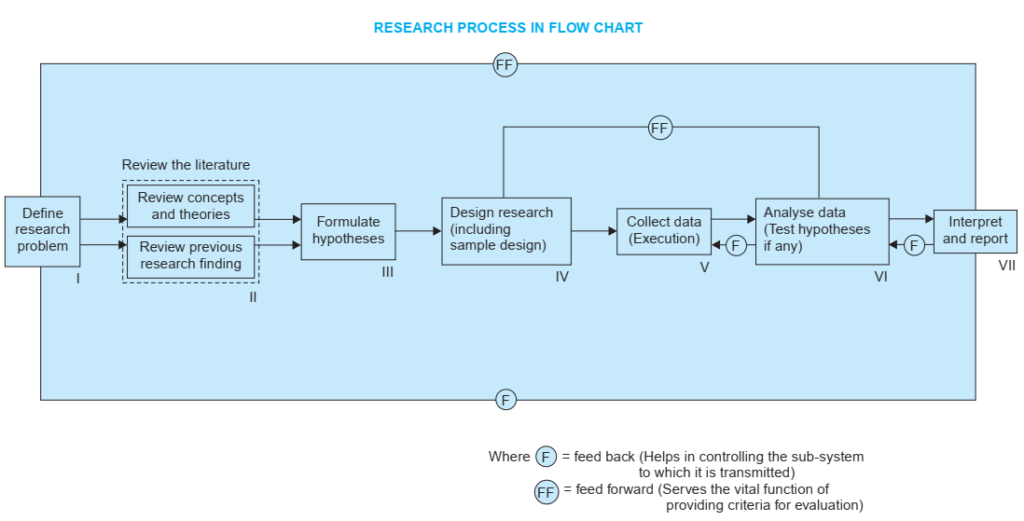
The chart highlights that the research process comprises several closely related activities, labeled I to VII. These activities often overlap and do not follow a rigid, linear sequence. In many cases, the initial steps influence the nature of the final steps. If later stages are not considered during the early phases, significant challenges may arise, potentially hindering the completion of the study. It is important to note that the steps in the research process are not mutually exclusive or entirely distinct. They do not always follow a fixed order, and researchers must anticipate the requirements of subsequent steps at each stage of the process.
However, the following sequence provides a useful procedural guideline for conducting research:
- Formulating the Research Problem: Defining the issue to be studied.
- Extensive Literature Review: Examining existing concepts, theories, and previous research findings.
- Developing the Hypothesis: Formulating testable predictions or assumptions.
- Preparing the Research Design: Planning the overall approach and structure of the study.
- Determining Sample Design: Selecting the sample population or data sources.
- Collecting Data: Gathering the necessary information or evidence.
- Execution of the Project: Implementing the research plan.
- Analysis of Data: Processing and interpreting the collected data.
- Hypothesis Testing: Evaluating the validity of the hypotheses.
- Generalizations and Interpretation: Drawing broader conclusions from the findings.
- Preparation of the Report: Presenting the results and conclusions in a formal written format.
This sequence serves as a practical framework for researchers, ensuring a systematic and organized approach to conducting studies. By following these steps, researchers can navigate the complexities of the research process and achieve meaningful, reliable outcomes.
Formulating the Research Problem
Research problems can be categorized into two types: those related to states of nature and those concerning relationships between variables. At the outset, a researcher must clearly identify the problem they wish to study by selecting a general area of interest or a specific aspect of a subject for investigation. Initially, the problem may be broadly stated, but any ambiguities should be resolved. The feasibility of a potential solution must also be assessed before arriving at a well-defined research problem. Thus, transforming a general topic into a specific research problem is the first step in scientific inquiry.
The process of formulating a research problem involves two key steps:
- Gaining a thorough understanding of the problem.
- Reframing it in precise, analytical terms.
A good way to develop this understanding is through discussions with colleagues or experts in the field. In academic settings, researchers can seek guidance from experienced mentors who often suggest broad research problems, leaving it to the researcher to refine and operationalize them. In private businesses or government organizations, research problems are typically identified by administrative agencies. Engaging with these agencies helps the researcher understand the origins of the problem and the factors influencing its potential solutions.
A thorough review of existing literature is essential to familiarize oneself with the selected problem. This involves analyzing two types of literature:
- Conceptual literature – which explores theories and underlying concepts.
- Empirical literature – which consists of previous studies related to the topic.
This review helps identify available data and resources, enabling the researcher to contextualize their problem effectively. Once the background is established, the problem must be rephrased in specific analytical or operational terms. Clearly defining the research problem is crucial, as it helps differentiate relevant data from irrelevant ones. Furthermore, verifying the objectivity and validity of background facts ensures a robust research foundation.
As Professor W.A. Neiswanger emphasizes, clearly stating research objectives is fundamental, as it determines:
- The data to be collected.
- The characteristics of relevant data.
- The relationships to be explored.
- The methodologies to be applied.
- The structure of the final report.
Additionally, key terms should be clearly defined during the formulation process. Research problem formulation typically follows a sequential approach, with each iteration becoming more precise, analytical, and realistic based on available data and resources. This iterative refinement ensures a well-structured and feasible research problem, forming the backbone of the entire research process.
Extensive Literature Survey
After formulating the research problem, the next step is to document a summary of it. For PhD candidates, it is mandatory to prepare a synopsis of the topic and submit it to the relevant Committee or Research Board for approval. At this stage, the researcher must conduct an extensive literature survey related to the problem.
To gather relevant literature, researchers should start with abstracting and indexing journals, as well as published or unpublished bibliographies. Depending on the nature of the study, valuable sources may include academic journals, conference proceedings, government reports, and books. It is important to recognize that one source often leads to another, helping to expand the scope of the research. Additionally, previous studies that are similar to the current research should be thoroughly examined for insights.
A well-equipped library serves as an invaluable resource during this phase, providing access to a wide range of materials essential for a comprehensive literature review.
Developing Working Hypotheses
After conducting an extensive literature review, a researcher must clearly define the working hypothesis or hypotheses. A working hypothesis is a tentative assumption formulated to test its logical or empirical implications. The process of developing hypotheses is crucial, as they serve as the foundation for research, influencing data collection, analysis methods, and overall research quality.
A well-defined hypothesis should be specific and tailored to the research at hand, ensuring it can be effectively tested. It guides the researcher by narrowing the scope of the study, maintaining focus on key aspects of the problem, and identifying the necessary data and analytical techniques.
Approaches to Developing Working Hypotheses:
- Discussions with experts and colleagues – Understanding the problem’s origin and research objectives.
- Examining existing data and records – Identifying trends, anomalies, and potential clues.
- Reviewing related studies – Learning from similar research to refine the hypothesis.
- Conducting exploratory investigations – Engaging in preliminary field interviews for deeper insights.
Working hypotheses emerge from prior knowledge, data analysis, related studies, and expert consultations. They should be stated clearly and precisely to maximize their usefulness. However, in exploratory or formulative research, where hypothesis testing is not the objective, working hypotheses may not be necessary. Nonetheless, in most research endeavours, formulating a hypothesis is a fundamental step in the research process.
Preparing the Research Design
Once the research problem has been clearly defined, the next step is to develop a research design—a structured framework that outlines how the study will be conducted. A well-prepared research design ensures efficiency, maximizing the collection of relevant information while minimizing effort, time, and cost.
The choice of research design largely depends on the study’s purpose, which generally falls into four categories:
- Exploration – Requires a flexible design to examine various aspects of the problem.
- Description – Focuses on accurately portraying a situation or relationships between variables, necessitating a design that minimizes bias and enhances data reliability.
- Diagnosis – Aims to identify causes and effects, often involving comparative or analytical methods.
- Experimentation – Tests hypotheses through controlled conditions, often using experimental research designs.
Types of Research Designs:
Research designs can be broadly classified into experimental and non-experimental hypothesis-testing methods. Experimental designs may be informal (e.g., before-and-after without control, after-only with control, before-and-after with control) or formal (e.g., completely randomized design, randomized block design, Latin square design, simple and complex factorial designs). The researcher must select the most suitable design for their study.
Key Considerations in Research Design Preparation:
- Methods for obtaining information.
- Availability and expertise of the researcher and their team.
- Justification for the chosen data collection methods.
- Time constraints.
- Financial resources are available for the research.
A well-structured research design serves as a blueprint for conducting the study effectively, ensuring valid and reliable results.
Determining Sample Design
In any research study, the entire set of items under investigation is referred to as the population or universe. A complete enumeration of all elements in the population is known as a census inquiry, which, in theory, eliminates chance and maximizes accuracy. However, in practice, census inquiries can introduce biases, be time-consuming, costly, and often impractical. Instead, researchers typically study a subset of the population, known as a sample.
To ensure the sample accurately represents the population, researchers must develop a sample design, which is a predetermined plan for selecting a subset of individuals or units before data collection begins. Sample designs can be classified into two broad categories:
- Probability Sampling – Each element in the population has a known probability of selection.
- Non-Probability Sampling – Selection probability is unknown, often based on researcher discretion.
Types of Sampling Methods
1. Non-Probability Sampling Methods
- Deliberate (Purposive) Sampling – Specific units are intentionally chosen to represent the population.
- Convenience Sampling – Selection is based on ease of access (e.g., interviewing customers at selected petrol stations).
- Judgment Sampling – The researcher selects participants based on subjective judgment (e.g., surveying students on new teaching methods).
- Quota Sampling – A variation of stratified sampling where quotas are set for different subgroups, but selection within each group is left to the interviewer’s discretion.
2. Probability Sampling Methods
- Simple Random Sampling – Every element has an equal chance of selection, typically using lottery methods or random number tables.
- Systematic Sampling – Selection follows a fixed interval (e.g., every 10th name on a list), with a random starting point to ensure randomness.
- Stratified Sampling – The population is divided into homogeneous subgroups (strata), and random samples are drawn from each stratum to ensure representativeness.
- Cluster Sampling – Instead of selecting individuals, entire groups (clusters) are chosen (e.g., selecting three clusters of credit card holders from a bank’s 15,000 customers).
- Area Sampling – A variation of cluster sampling, often used for geographical studies where the total area is divided into smaller, non-overlapping zones, and samples are drawn from selected areas.
- Multi-Stage Sampling – A hierarchical sampling approach, where large primary units (e.g., states) are selected first, followed by smaller units (e.g., districts, towns, families).
- Sequential Sampling – The sample size is not fixed in advance but is determined progressively based on the information collected during the study, often used in quality control.
Choosing the Right Sample Design
In practice, multiple sampling techniques may be combined, known as mixed sampling, to optimize efficiency and cost. While random sampling is preferred for minimizing bias and estimating sampling errors, purposive sampling is useful for small populations or when studying specific characteristics in depth. The final choice of sample design should consider the nature of the research, available resources, and the study’s objectives.
Collecting the Data
In addressing real-world problems, researchers often find that existing data are insufficient. Therefore, it becomes necessary to collect relevant data through appropriate methods. The choice of data collection techniques depends on factors such as cost, time, and available resources.
Primary Data Collection Methods
Primary data can be gathered through experiments or surveys:
- In an experiment, the researcher observes and records quantitative measurements to test a hypothesis.
- In a survey, data are collected through one or more of the following methods:
1. Observation
- Involves collecting data through direct observation without interacting with respondents.
- Captures real-time information without being influenced by respondents’ past actions or future intentions.
- Although useful, this method is expensive and limited in scope, making it impractical for large-scale studies.
2. Personal Interviews
- A structured approach where the researcher follows a set of predetermined questions.
- The quality of data depends largely on the interviewer’s skill and ability to elicit accurate responses.
3. Telephone Interviews
- Involves collecting data by calling respondents directly.
- Less commonly used but effective for industrial surveys, especially when time is limited.
4. Mailed Questionnaires
- Questionnaires are sent to respondents, who complete and return them.
- A widely used method in business and economic surveys.
- Typically preceded by a pilot study to identify weaknesses in the questionnaire design.
- The effectiveness of this method depends on the clarity and relevance of the questions.
5. Schedules
- Enumerators (trained data collectors) visit respondents and fill out schedules based on their responses.
- The reliability of data depends on the competence of the enumerators.
- Occasional field checks help ensure accuracy and sincerity in data collection.
Choosing the Right Method
The selection of a data collection method depends on several factors, including:
- Nature of the study
- Research objectives
- Scope of the inquiry
- Available financial resources
- Time constraints
- Required level of accuracy
While all these factors are important, the experience and judgment of the researcher play a crucial role. As Dr. A.L. Bowley aptly stated, “In the collection of statistical data, common sense is the chief requisite and experience the chief teacher.”
Project Execution
The execution phase is a critical step in the research process. A well-executed project ensures that the collected data is both sufficient and reliable. To achieve this, the researcher must oversee the process systematically and ensure timely completion.
If the research involves structured questionnaires, data can be efficiently processed using machine-readable formats. In such cases, both the questions and possible responses should be coded in advance.
For studies that rely on interviews, proper selection and training of interviewers is essential. Training can be facilitated through instruction manuals that outline each step of the data collection process. Additionally, field checks should be conducted periodically to verify that interviewers are carrying out their tasks diligently and accurately.
To maintain realism and accuracy, researchers must anticipate and address unforeseen challenges. This means ensuring that the survey remains under statistical control, adhering to predefined accuracy standards.
In cases where respondents are uncooperative, researchers should employ strategies to mitigate non-response bias. One approach is to compile a list of non-respondents, select a small sub-sample, and make additional efforts—possibly with expert assistance—to obtain responses.
Data Analysis
Once data collection is complete, the next crucial step is data analysis, which involves several interrelated processes such as categorization, coding, tabulation, and statistical inference. Since raw data can be vast and complex, it must be systematically organized into meaningful and manageable groups for effective analysis.
The first step is classification, where raw data is grouped into relevant categories. Coding follows, converting these categories into symbols that can be tabulated and counted. To enhance data quality before coding, editing is performed to identify and correct errors.
With coding complete, tabulation organizes the data into structured tables, often using computational tools to efficiently process large datasets. The use of computers significantly reduces processing time and allows for the simultaneous examination of multiple variables.
During analysis, researchers apply statistical methods such as percentages, coefficients, and other mathematical tools to interpret the data. Statistical tests are essential for verifying the significance of relationships or differences in the data.
For instance, if two samples of weekly wages from different factory locations within the same city yield distinct mean values, a researcher must determine whether this difference is statistically significant or a result of random variation. By applying statistical significance tests, researchers can confirm whether the samples represent different populations or stem from the same universe. Similarly, analysis of variance (ANOVA) helps determine whether variations in factors—such as different seed varieties used in farming—lead to significantly different outcomes.
In essence, statistical tools provide researchers with a reliable framework to draw valid conclusions, ensuring that findings are based on sound evidence rather than mere chance.
Hypothesis Testing and Interpretation
Once the data has been analyzed, the next step is hypothesis testing. The researcher must determine whether the collected data supports or contradicts the initial hypothesis. This involves applying various statistical tests, such as the Chi-square test, t-test, and F-test, depending on the nature and objectives of the research. These tests help in validating or rejecting the hypothesis with a certain degree of confidence.
If a hypothesis is confirmed, it strengthens the foundation of the research findings. However, if the hypothesis is rejected, the researcher may need to reassess the study’s assumptions or explore alternative explanations. In cases where no hypothesis was initially formulated, the findings themselves may be used to establish new hypotheses for future studies.
Generalisations and Interpretation
When a hypothesis is repeatedly tested and validated, it may lead to the formulation of generalizations or even contribute to the development of a theory. The ability to derive broad, applicable conclusions is one of the key objectives of research.
If no hypothesis was initially proposed, the researcher may attempt to explain the findings through existing theories or frameworks—this process is known as interpretation. Effective interpretation not only helps in understanding the research outcomes but also raises new questions, often leading to further investigation and subsequent studies.
Preparation of the Report or Thesis
The final step in the research process is preparing a comprehensive report or thesis that documents the entire study. This should be done with great precision, ensuring clarity, coherence, and logical structure.
1. Report Layout
The report should be structured into three main sections:
- Preliminary Pages: Includes the title, date, acknowledgements, foreword, table of contents, and lists of tables, graphs, and charts (if applicable).
- Main Text: The core of the report, which consists of:
- Introduction: Clearly states the research objectives, methodology, scope, and any limitations.
- Summary of Findings: Provides a concise, non-technical overview of key findings and recommendations. If the findings are extensive, they should be summarized for clarity.
- Main Report: Presents the detailed research findings in a logical, structured format, divided into identifiable sections.
- Conclusion: Summarize the research results concisely, highlighting key takeaways.
- End Matter: Includes appendices for technical data, a bibliography listing all references (books, journals, and reports), and an index (especially for published research).
2. Writing Style
- The report should be written in a concise and objective manner using simple, clear language.
- Avoid vague expressions like “it seems,” “there may be,” or similar ambiguous terms.
3. Use of Visuals
- Charts, graphs, and illustrations should be incorporated only when they enhance clarity and strengthen the presentation of data.
4. Accuracy and Transparency
- Confidence limits (statistical accuracy) should be stated.
- Any challenges or constraints encountered during the research should also be acknowledged.
By following these guidelines, the research report will be well-structured, professional, and impactful.
Criteria of Good Research
Regardless of the type of research or study, all scientific investigations share a common foundation: the application of the scientific method. For research to be considered scientifically sound, it should meet the following criteria:
- Clear Purpose and Common Concepts: The research objectives should be explicitly defined, and commonly understood concepts should be used to ensure clarity and consistency.
- Detailed Research Procedure: The methodology should be described in sufficient detail to allow other researchers to replicate the study. This ensures the continuity of knowledge and enables further advancements based on existing findings.
- Carefully Planned Design: The research design should be meticulously structured to produce results that are as objective as possible, minimizing bias and errors.
- Transparency in Reporting: The researcher should openly acknowledge any flaws or limitations in the procedural design and assess their potential impact on the findings.
- Thorough Data Analysis: Data should be analyzed rigorously to uncover its significance. The methods of analysis should be appropriate, and the validity and reliability of the data must be carefully verified.
- Justified Conclusions: Conclusions should be based solely on the data collected and should not extend beyond what the data supports. They must be grounded in evidence and provide a solid basis for interpretation.
- Researcher Credibility: Greater confidence in the research is warranted if the researcher has a strong track record, a good reputation in the field, and demonstrates integrity.
Qualities of Good Research
In addition to the above criteria, good research can be characterized by the following qualities:
- Systematic Approach: Good research is structured and follows a defined sequence of steps in accordance with established rules. While creativity is encouraged, reliance on guesswork or intuition to draw conclusions is not acceptable.
- Logical Reasoning: Research should be guided by the principles of logical reasoning. Both inductive reasoning (from specific observations to broader generalizations) and deductive reasoning (from general premises to specific conclusions) play a crucial role in making research meaningful, especially in decision-making contexts.
- Empirical Basis: Good research is grounded in real-world phenomena and deals with concrete data. This connection to reality enhances the external validity of the research findings.
- Replicability: A key characteristic of good research is that it can be replicated. The ability to verify results through repeated studies strengthens the reliability of the findings and provides a solid foundation for decision-making.
By adhering to these criteria and qualities, research can achieve scientific rigor, credibility, and practical relevance.
Challenges Faced by Researchers in India
Researchers in India, particularly those involved in empirical research, encounter numerous challenges that hinder the quality and progress of their work. Some of the most significant issues include:
- Lack of Scientific Training in Research Methodology: A major obstacle for researchers in India is the insufficient training in research methodology. Many researchers lack the necessary skills and knowledge, leading to poorly designed studies. Often, research is reduced to a superficial “cut-and-paste” exercise without meaningful analysis or insights. This results in findings that fail to reflect reality. To address this, there is an urgent need for systematic training in research methods. Short-term, intensive courses should be made available to equip researchers with the methodological expertise required for high-quality research.
- Limited Interaction Between Academia and Industry: There is a noticeable gap between university research departments and key stakeholders such as businesses, government departments, and research institutions. Valuable primary data often remain unused due to a lack of proper connections. Establishing stronger ties between academia and industry is essential for conducting relevant and practical research. Mechanisms for university-industry collaboration should be developed to ensure that academic research addresses real-world problems and that industry benefits from academic insights.
- Reluctance of Businesses to Share Information: Many businesses in India are hesitant to share data with researchers due to concerns about misuse. The culture of secrecy within organizations creates a significant barrier for researchers. Building trust and ensuring confidentiality are crucial to overcoming this challenge. Researchers must demonstrate that the information provided will be used responsibly and ethically.
- Duplication of Research Efforts: Overlapping research studies are common due to inadequate access to information about ongoing research. This leads to unnecessary duplication and wastage of resources. To mitigate this, a comprehensive and regularly updated database of research topics and ongoing projects should be maintained. Identifying research problems that are directly relevant to industries and applied sciences should also be prioritized.
- Absence of a Code of Conduct for Researchers: The lack of a standardized code of conduct for researchers, coupled with inter-university and inter-departmental rivalries, further complicates the research landscape. Developing and implementing a code of conduct could help foster collaboration and ethical practices among researchers.
- Inadequate Secretarial and Technical Support: Many researchers face delays due to insufficient secretarial and technical assistance, including computer support. Timely and efficient support services are essential for the smooth completion of research projects. The University Grants Commission (UGC) should take proactive steps to address this issue and ensure that researchers have access to the necessary resources.
- Inefficient Library Management: Poor library management is a common issue, with researchers spending excessive time locating books, journals, and reports rather than analyzing relevant materials. Improving library systems and making resources more accessible would significantly enhance research efficiency.
- Delayed Access to Government Publications: Many libraries struggle to obtain copies of old and new Acts, Rules, reports, and other government publications in a timely manner. This problem is particularly acute in libraries located far from Delhi or state capitals. Efforts should be made to ensure the regular and prompt supply of government publications to all libraries.
- Inconsistent and Delayed Data Availability: Researchers often face difficulties in accessing timely and consistent data from government and other agencies. Variations in data coverage by different agencies further complicate the research process. Streamlining data collection and dissemination processes would greatly benefit researchers.
- Conceptualization and Data Collection Challenges: Researchers may encounter difficulties in conceptualizing research problems and in the process of data collection. Addressing these issues requires better training, clearer guidelines, and improved access to resources.
By addressing these challenges, India can create a more conducive environment for high-quality research, fostering innovation and contributing to the nation’s development.
Conclusion
In conclusion, exploring social science research reveals a dynamic and multifaceted field that seeks to understand the complexities of human behaviour, societal structures, and cultural phenomena. Through a variety of research methods—ranging from quantitative surveys and experiments to qualitative interviews and ethnographic studies—social scientists can uncover insights that inform policy, challenge assumptions, and contribute to the betterment of society. The interdisciplinary nature of social science research allows for a holistic understanding of issues, bridging gaps between theory and practice. By adhering to rigorous methodologies and ethical standards, researchers ensure that their findings are not only credible but also impactful, offering solutions to real-world problems and fostering a deeper understanding of the human experience.
Ultimately, the value of social science research lies in its ability to provide evidence-based insights that drive social change and innovation. Whether addressing global challenges like inequality and climate change or exploring local community dynamics, social science research plays a pivotal role in shaping a more informed and equitable world. As the field continues to evolve, embracing new technologies and methodologies, it remains essential for researchers to remain adaptable, collaborative, and committed to the pursuit of knowledge. By doing so, social science research will continue to illuminate the intricacies of human societies and inspire meaningful progress for generations to come.