The United Nations’ International Strategy for Disaster Reduction (ISDR) defines a hazard as “a potentially damaging physical event, phenomenon, or human activity that may result in loss of life, injury, property damage, social and economic disruption, or environmental degradation.” Hazards can be natural (geological, hydrometeorological, or biological) or human-induced (such as environmental degradation or technological hazards). They may occur as single events, sequentially, or in combination, with varying origins and impacts. Hazard analysis involves identifying, studying, and monitoring hazards to assess their potential, origin, and characteristics.
A subtle distinction exists between environmental hazards and resources. For example, uncontrolled water constitutes a flood hazard, while controlled water serves as a reservoir resource. Similarly, the atmosphere is deemed “benign” when it provides pleasant weather but “hostile” when it produces destructive phenomena like the damaging ‘loo’ winds (Smith, 1996).
A disaster arises from natural or human-induced causes, leading to a sudden disruption of normal life and causing severe damage to life and property. This damage often exceeds the capacity of existing social and economic protection mechanisms. It is crucial to differentiate between “hazards” and “disasters.” Natural events like floods or cyclones become disasters when a combination of factors—natural, human, or both—transforms the hazard into a catastrophic event. A disaster, therefore, represents the actual occurrence of a feared catastrophe.
Disasters result from a cause-effect dynamic driven by endogenous (inherent) and exogenous (external) factors that amplify the event into a large-scale destructive phenomenon. Vulnerabilities that persist unchecked over time eventually culminate in a disaster. Disasters disrupt societal equilibrium, which can be restored through proactive policies. The traditional view of disasters as purely natural phenomena beyond human control is increasingly being replaced by a “systems perspective.” This approach integrates ecological and social dimensions, understanding disasters as complex events shaped by the interplay of human actions and environmental contexts (Oliver-Smith and Hoffman, 1999). Societies interact with their environment through values, perceptions, and processes—such as development and planning—over which they have limited control and knowledge. Over time, these interactions can turn underlying hazards into disasters (Oliver-Smith, 1999). From a systems perspective, hazards act as catalysts, revealing latent tensions and pressures. This framework is essential for understanding the root causes of disasters (Watts, 1983).
Table of Contents
Meaning of Disaster
The United Nations International Strategy for Disaster Reduction (UNISDR) (2009) defines a disaster as:
“A serious disruption of the functioning of a community or a society involving widespread human, material, economic, or environmental losses and impacts, which exceeds the ability of the affected community or society to cope using its own resources.”
As per the Disaster Management Act 2005, a disaster is defined as:
“A catastrophe, mishap, calamity, or grave occurrence in any area, arising from natural or man-made causes, or by accident or negligence, which results in substantial loss of life or human suffering, damage to or destruction of property, or degradation of the environment, and is of such a nature or magnitude as to be beyond the coping capacity of the community of the affected area.”
UNISDR emphasizes that disasters result from a combination of factors, including:
- Exposure to hazards
- Conditions of vulnerability
- Insufficient capacity or measures to reduce or cope with potential negative consequences
Disasters affect individuals, communities, and the environment in various ways. The table below summarizes the key impacts:
| Category | Impacts |
|---|---|
| Individual | Psychological and emotional trauma; injuries, diseases; negative effects on physical, mental, and social well-being. |
| Physical | Damage to property and destruction of assets. |
| Human | Loss of life. |
| Governance | Loss of services and administrative problems. |
| Social | Social and economic disruption; women, children, and the elderly are the most vulnerable groups. |
| Environmental | Environmental degradation. |
Key Takeaways
- Disasters are complex events that arise from a combination of hazards, vulnerabilities, and insufficient coping mechanisms.
- Their impacts are multifaceted, affecting individuals, infrastructure, governance, society, and the environment.
- Addressing disasters requires a holistic approach that integrates risk reduction, capacity building, and sustainable development.
Classification of Disasters
Disasters are categorized based on their origin into natural and man-made types. They are also classified by severity as minor or major, depending on their impact. However, such classifications are often more theoretical than practical, as major disasters may simply be events that receive greater media attention (Parasuraman and Unnikrishnan, 2005).
In August 1999, the High Powered Committee (HPC) was established under the leadership of J.C. Pant. The HPC’s mandate was to develop comprehensive model plans for disaster management at the national, state, and district levels. This initiative marked India’s first systematic, holistic, and comprehensive approach to addressing all types of disasters. The HPC identified around 30 disasters, which were grouped into the following five categories based on generic considerations:
Classification of Disasters by the High Powered Committee (HPC):
| Category | Disasters |
|---|---|
| 1. Water and Climate | Floods, Cyclones, Tornadoes and hurricanes, Hailstorms, Cloudburst, Heat waves and cold waves, Snow avalanches, Droughts, Sea erosion, Thunder/lightning. |
| 2. Geological | Landslides and mudflows, Earthquakes, Large fires, Dam failures and dam bursts, Mine fires. |
| 3. Biological | Epidemics, Pest attacks, Cattle epidemics, Food poisoning. |
| 4. Chemical, Industrial, and Nuclear | Chemical and industrial disasters, Nuclear disasters. |
| 5. Accidental | Forest fires, Urban fires, Mine flooding, Oil spills, Major building collapses, Serial bomb blasts, Festival-related disasters, Electrical disasters and fires, Air, road, and rail accidents, Boat capsizing, Village fires. |
Key Takeaways
- Disasters are broadly classified into natural and man-made types, with further categorization based on severity.
- The High Powered Committee (HPC) played a pivotal role in systematically identifying and grouping disasters into five major categories.
- This classification provides a structured framework for disaster management planning at national, state, and district levels in India.
Global Dimensions of Disasters
Disaster losses have been on the rise globally, driven by rapid urbanization and population growth. According to the United Nations, in 2001 alone, medium to high-intensity natural disasters caused at least 25,000 deaths worldwide—more than double the previous year—and resulted in global economic losses exceeding $36 billion. These figures exclude numerous small-scale events that severely impacted local economies and disrupted lives, often permanently. Notable disasters that year included earthquakes in Gujarat (India), El Salvador, and Peru; floods across Asia, Africa, and other regions; droughts in Central Asia, Afghanistan, and Central America; cyclones in Madagascar and Orissa (India); and floods in Bolivia. Global disaster statistics from 1996 to 2000 reveal staggering losses, with estimated economic costs of $235 billion and 425,000 lives lost (CRED International Disaster Database).
Over the past decade, disasters caused by natural hazards alone have affected an average of 211 million people annually. Asia bears the brunt of these disasters, accounting for nearly half of the world’s major natural disasters recorded over the past three decades. As a result, Asia has become the most disaster-prone region globally, representing 80% of the total affected populations, 40% of total deaths, and 46% of total economic losses (CRED statistics, 1997–2001).
Disasters have far-reaching international ramifications, both direct and indirect, underscoring the need for coordinated global efforts to address regional vulnerabilities. Developing countries suffer disproportionately due to their limited capacity to cope with large-scale disasters and higher levels of physical, social, and economic vulnerability. Since 1991, two-thirds of disaster victims have been from developing countries, compared to just 2% from developed nations.
Asia, in particular, faces significant disaster risks. Between 1991 and 2000, 554,439 deaths occurred in Asia, compared to 1,159 casualties in the rest of the world. Within Asia, 24% of the casualties occurred in India, reflecting its large population, geographic size, and vulnerability. Floods and high winds account for the majority of deaths in India (Tenth Plan, 2002–2007).
Between 1994 and 2003, disasters—both natural and technological—claimed 68,671 lives in India, affected an average of 68 million people annually, and caused $1.9 billion in direct economic damage each year. This toll exceeded that of the previous decade, highlighting the urgent need to strengthen the resilience of Indian communities to disasters (World Disasters Report, 2004).
Key Takeaways
- Disaster losses are increasing globally due to urbanization and population growth, with significant human and economic costs.
- Asia is the most disaster-prone region, accounting for a disproportionate share of global disaster impacts.
- Developing countries, including India, are particularly vulnerable due to limited coping capacities and higher levels of socio-economic vulnerability.
- Coordinated international efforts are essential to address disaster risks and build resilience in vulnerable regions.
Overview of Natural Disasters in India
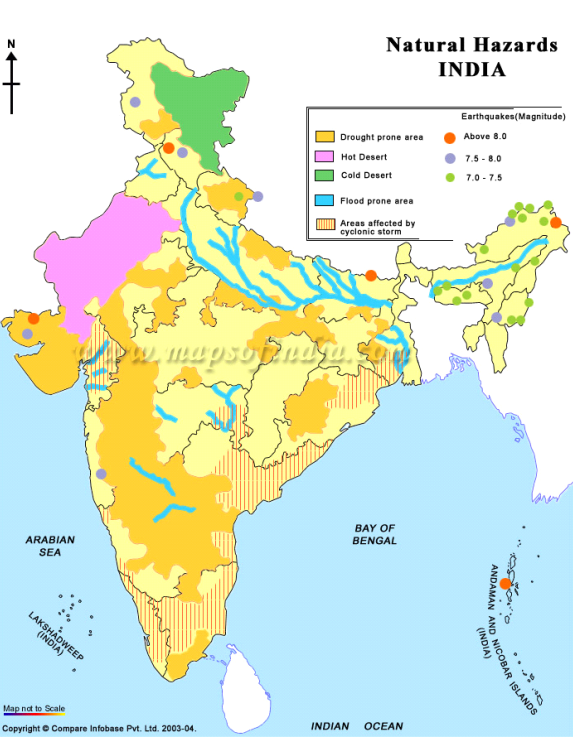
India’s key vulnerabilities, as outlined in the Tenth Plan (2002–07), include the following:
- Coastal states, particularly on the east coast and Gujarat, are prone to cyclones.
- 40 million hectares of land are vulnerable to floods.
- 68% of the net sown area is susceptible to droughts.
- 55% of India’s total land area falls in seismic zones III–V, making it vulnerable to earthquakes.
- The sub-Himalayan region and Western Ghats are prone to landslides.
The following sections provide a brief analysis of India’s vulnerabilities to specific natural hazards (Menon and Kalmadi).
Floods
India’s monsoon season (June–September) accounts for 75% of annual rainfall, causing rivers to carry heavy discharge during this period. Issues such as sediment deposition, drainage congestion, and the synchronization of river floods with sea tides exacerbate flood risks, particularly in coastal plains. The Brahmaputra and Gangetic basins are the most flood-prone regions. Other vulnerable areas include:
- The northwest region with west-flowing rivers like the Narmada and Tapti.
- Central India and the Deccan region with major east-flowing rivers like the Mahanadi, Krishna, and Cauvery.
While the total flood-prone area is 40 million hectares, the average area affected annually is approximately 8 million hectares.
Droughts
India’s irrigation systems are heavily reliant on monsoon rains. Erratic rainfall patterns—both low (less than 750 mm) and medium (750–1125 mm)—make 68% of the total area vulnerable to periodic droughts. A 100-year analysis reveals that below-normal rainfall occurs 54–57% of the time in arid, semi-arid, and sub-humid regions. Severe droughts occur every 8–9 years in arid and semi-arid zones, which cover 76% of the area. Rare, most severe droughts occur approximately once every 32 years, with almost every third year being a drought year.
Cyclones
India’s long coastline faces two distinct cyclone seasons: pre-monsoon (May–June) and post-monsoon (October–November). Cyclone impacts are confined to coastal districts, with maximum destruction occurring within 100 km of the cyclone’s center and along its track. The primary causes of casualties are coastal inundation by tidal waves, storm surges, and torrential rains.
Earthquakes
The Himalayan mountain ranges, among the world’s youngest fold mountains, are geologically active. In the past 53 years, four earthquakes exceeding magnitude 8 on the Richter scale have occurred in this region. While the peninsular part of India is considered stable, the 1993 Latur earthquake in Maharashtra (magnitude 6.4) caused significant loss of life and infrastructure damage.
Landslides and Avalanches
- Landslides: The Himalayas, northeast hill ranges, and Western Ghats experience frequent landslide activity due to river erosion, seismic movements, and heavy rainfall. Cyclonic disturbances during the monsoon often trigger landslides in the Western Ghats.
- Avalanches: These pose a significant hazard in the higher reaches of the Himalayas, particularly in Jammu & Kashmir, Himachal Pradesh, and the hills of Uttar Pradesh. Regions like the Nubra and Shyok valleys, with a population of about 20,000, as well as mountaineers and trekkers, face avalanche risks due to steep terrain.
Disasters in Odisha
Odisha has faced recurrent natural disasters since ancient times due to its unique geo-climatic conditions. The state is prone to a wide range of calamities, including floods, cyclones, fires, hailstorms, droughts, lightning, heatwaves, earthquakes, and tsunamis. Among these, floods, cyclones, hailstorms, fires, and heat waves are particularly frequent and intense, causing widespread suffering and disruption. Located on the northern part of the east coast, Odisha is highly vulnerable to cyclones. Additionally, the state often experiences droughts due to erratic monsoon patterns. A significant portion of Odisha also falls under seismic zones, making it susceptible to earthquakes. These recurrent disasters have severely hindered the state’s socio-economic development.
Odisha’s geographical location along the Bay of Bengal makes it highly susceptible to multiple hazards. The socio-economic vulnerability of its population exacerbates the impact of these hazards, turning them into disasters. With nearly 90% of the population living in disaster-prone areas and approximately 38% below the poverty line, the state’s coping mechanisms are under constant strain. Despite various initiatives to enhance community preparedness, the frequency and severity of disasters leave little room to fully realize the benefits of these efforts. Consequently, the state often finds itself oscillating between repair/reconstruction and preparedness, as well as relief and rehabilitation.
Odisha’s disaster mitigation efforts are guided by the Odisha Relief Code (ORC), a comprehensive document that outlines preparedness measures for the pre-disaster phase and relief operations during the post-disaster phase. The ORC covers a wide range of disasters, including droughts, floods, cyclones, earthquakes, heavy rains, tidal waves, fires, transport accidents, epidemics, and locust infestations. At the district level, District Contingency Plans are prepared to ensure effective preparedness, rescue, relief, and restoration actions. The ORC empowers District Collectors to oversee relief operations, while Sub-Collectors, Tahsildars, and Block Development Officers (BDOs) play critical roles in managing relief and rehabilitation efforts.
In addition to the ORC, the Odisha State Disaster Mitigation Authority (OSDMA), an autonomous body, is tasked with restoring livelihoods, reconstructing damaged infrastructure, and enhancing the state’s preparedness for future calamities. OSDMA collaborates with various stakeholders, including bilateral/multilateral agencies, NGOs, and INGOs, to coordinate restoration, reconstruction, and rehabilitation programs.
In line with the state’s broader efforts to improve disaster preparedness, management, and mitigation, the ST & SC Development, M & BCW Department has formulated a Draft Disaster Management Plan. This plan aims to establish an effective and realistic mechanism within the department to ensure proper and timely actions related to prevention, mitigation, response, and post-disaster relief, rehabilitation, and reconstruction. The goal is to achieve zero or minimal loss of life and reduce property damage.
This document serves as a communication and reference tool, clearly defining the roles and responsibilities of department officials at various levels. It also outlines standard operating procedures (SOPs) for immediate local responses and establishes coordination mechanisms with key departments and units for preparedness, rescue, and relief operations. The plan emphasizes preparedness across the department’s institutions, including offices, schools, and hostels, recognizing that prevention is far more cost-effective than post-disaster relief and rehabilitation.
Key Takeaways
- Odisha’s geo-climatic conditions make it highly vulnerable to a wide range of natural disasters, including cyclones, floods, droughts, and earthquakes.
- The state’s socio-economic challenges, such as high poverty levels, exacerbate the impact of disasters.
- Disaster mitigation efforts are guided by the Odisha Relief Code (ORC) and supported by the Odisha State Disaster Mitigation Authority (OSDMA).
- The Draft Disaster Management Plan of the ST & SC Development, M & BCW Department aims to enhance preparedness, response, and recovery efforts, with a focus on minimizing loss of life and property.
Conclusion
Disasters are unwelcome events that disrupt normal life and derail developmental progress. They can arise from natural causes, human activities, or a combination of both. The impact of disasters is often more severe in communities that are vulnerable, whether due to physical exposure or socio-economic disadvantages. As such, disaster management is a critical aspect of public administration, requiring timely mitigation efforts through effective public policies.
In the context of postmodernism, the sustainability of development has become a top priority. This shift reflects a broader recognition that progress cannot be sustained if it conflicts with environmental preservation. Environmental concerns are increasingly significant, as environmental factors are contributing to the rising frequency and intensity of disasters. Sustainable development is now largely framed in terms of sustainable urban growth. While rural development remains important, urban development demands greater attention and regulation through well-planned policies. Rural areas often benefit indirectly from the positive externalities generated by nearby urban centers, as highlighted in the Tenth Plan.
A key area of concern is urban risk, driven by the growing concentration of populations in cities without corresponding investments in safety measures. Disaster management must be integrated into a developmental framework, with proactive measures taken to minimize the impact of disasters. By addressing these challenges, we can build more resilient communities and ensure sustainable progress for the future.
References
- International Strategy for Disaster Reduction: Available at http://www.isdr.org.
- International Red Cross and Red Crescent Societies. “Man-made Disasters.” Available at www.icrc.org.
- Inglehart, Ronald. Modernization and Postmodernization: Cultural, Economic and Political Change in 43 Societies. Princeton University Press, Princeton, NJ, 1997.
- McLeod, David. “Postmodernism in Urban Planning.” Planning & Environmental Information. Available at http://www3.sympatico.ca/David.macleod/PINFO.HTM, 2003.
- Menon, Vinod C., and Suresh Kalmadi. “Background and Perspective.” Infochange Disasters. Available at http://www.infochangeindia.org/DisastersIbp.jsp#04.
- Moorthy, Krishna V., and Bhaskar Karnick. I DRIVE SAFELY – Let Peace Prevail on Our Roads. Available at http://www.idrivesafely.com.
- Oliver-Smith, Anthony. “Peru’s Five Hundred Year Earthquake: Vulnerability in Historical Context.” In The Angry Earth, edited by Anthony Oliver-Smith and Susanna Hoffman, Routledge, New York, 1999.
- Parasuraman, S., and P.V. Unnikrishnan. “Disaster Response in India: An Overview.” India Disasters Report, Punjablok, 2005.
- Report of the High-Powered Committee (HPC) for Preparation of Disaster Management Plans. Government of India, New Delhi, 2001.
- Smith, K. Environmental Hazards. Routledge, London, 1996.
- State of Environment Report for Delhi 2001: Key Environmental Concerns. Available at http://www.static.teriin.org.
- Watts, Michael. “On the Poverty of Theory: Natural Hazards Research in Context.” In Interpretations of Calamity, edited by K. Hewitt, Allen & Unwin, Boston, London, and Sydney, 1983.
- Website of the National Disaster Management Division, Ministry of Home Affairs, Government of India. Available at http://www.ndmindia.nic.in.
- Wikipedia, the Free Encyclopedia. “2005 Maharashtra Floods.” Available at http://www.en.wikipedia.org.